
In Defense of Laptops in Coffee Shops
For me, a coffee shop is not a superfluity or an afterthought. It is infrastructure.
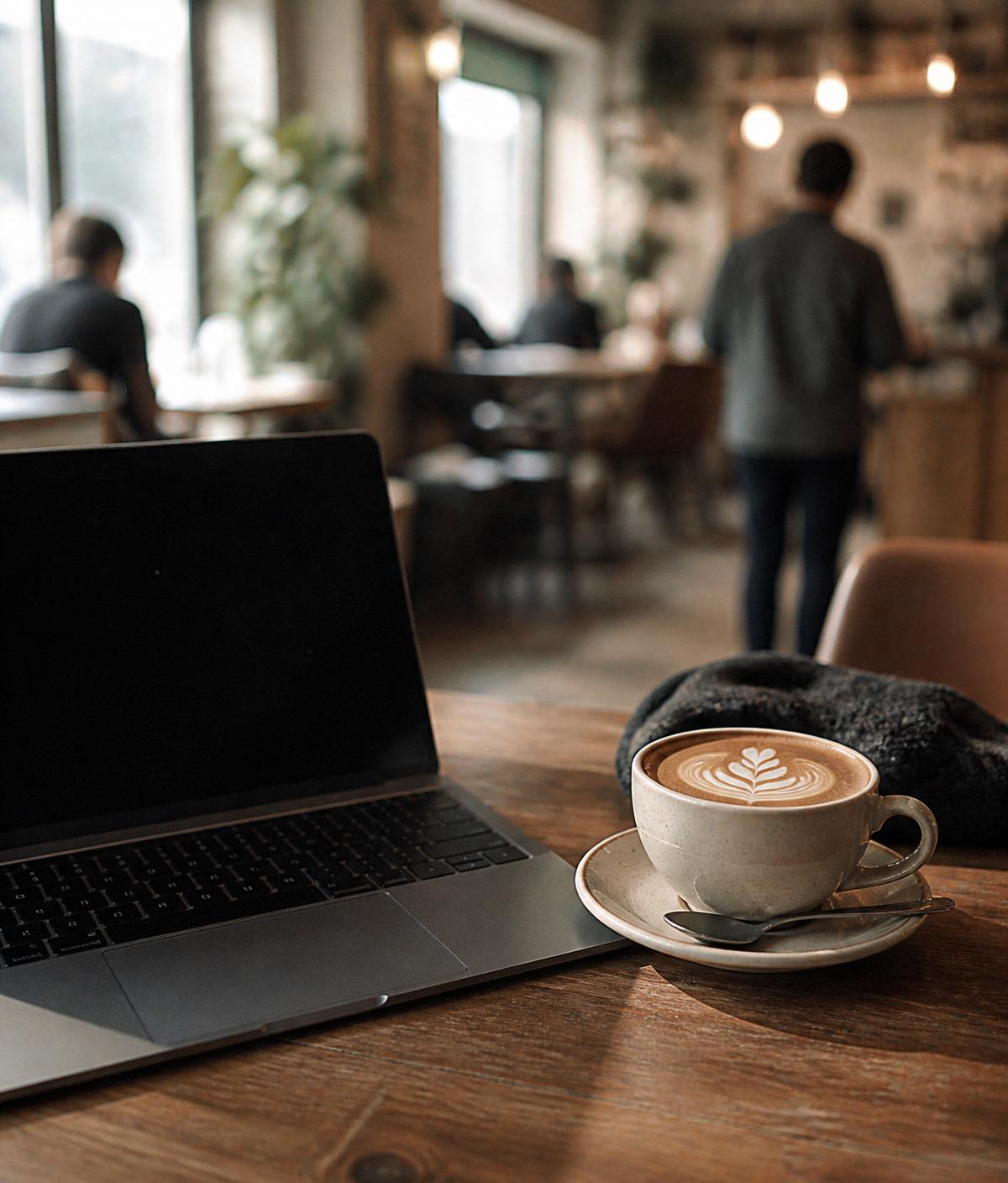
When looking for my last apartment, I had three nonnegotiable amenities: air conditioning, in-building washer and dryer, and a good coffee shop within a maximum two block radius. It is a widely shared hierarchy of needs, a signal for how culture has organized itself around life’s demands.
For me, a coffee shop is not a superfluity or an afterthought. It is infrastructure. Despite rejecting coffee that was either hot or contained less than a pack of Stevia until the ripe age of 20, I came around eventually, the way most people do — gradually, then completely. The animating force behind my daily rhythm, I often think of my years in New York in coffee shops, brick and mortar manifestations of my life and its phases: Solid State and Irving Farm in the Upper West Side, Urbana and Sullivan Street in Chelsea, Thayer and Cafe Chrystie in Alphabet City.
I arrived to New York with recently acquired fantasies of coffee shop as sites of collision. Visits to even the savorless likes of Blue Bottle conjured visions of the Viennese coffeehouse culture, where I imagined myself embedded in rooms where artists, musicians, and writers mingled and composed and argued and observed. I traced the countercultural bloodline of the institution, a place where private life and public life have always negotiated their terms. I dreamed of Café Central, dense with the likes of Freud and Trotsky, and of the West Village cafés of the sixties that fed the folk revival, the gay rights movement, and the Beats. A trip to the coffee shop in my mind was never only about the acquisition of a drink. It was about participating in a tradition of people who came to see and be seen.
The energy of this New York, as reality tends to, arrived more slowly. As deep and fulfilling as my move into the city was, the transition was hard won. My first few months were riddled with epic highs and lows — the overwhelming brightness of new experiences coupled with moments of loneliness and disconnection that made the city feel enormous in the wrong way. Still, I returned to coffee shops, finding a stabilizing force within them. A consistent place to exist, to feel.
While it felt lame to admit at the time, I now view it as an honest and natural part of re-rooting oneself, a practice that was born from change and amplified by the individualism of those around me. The quasi-community absorbed through proximity was key to combatting the negative byproducts of New York’s famously independent attitude. What began as compensation slowly became practice. My days organized themselves around opening and closing hours: 7:30am at the Hungarian Pastry Shop, 1am at Qawah House. I extended into coffee shops as I learned how to be comfortable existing solo.
Third spaces
In New York, the coffee shop is one of the few rooms that belong, at least in theory, to everyone. The retiree nursing a cup of drip, the artist who came to people-watch, the friends catching up after months of separation, each pursuing a different small project of being a person. Coffee shops are malleable in this way: undefined, dynamic, capacious enough to absorb the endless variations of meetings that arise across a life and across a day.
But while most functions of a coffee shop remain relatively uncontested, the coffee shop as a workspace has become subject to a particular kind of cultural scrutiny that has intensified in recent years. And much of that scrutiny travels under the language of the “third space.”
Ray Oldenburg, who coined the term “third space,” described it as neutral ground — a leveler, a place that makes a community legible to itself. Third spaces, in his framing, were sites of gathering not as consumers or employees or residents but simply as people. The operative word was always neutral.
Today, the term has expanded beyond its non-consumer origins to denote, more loosely, any space of mutual existence. The category has grown porous, broad enough now to hold the bookstore, the gym, the corner bar, the running track, anywhere strangers cohabitate without obligation. As the discourse has stretched further still to invoke “fourth spaces” (environments that bridge digital relationships and physical realities, like run clubs or community events organized through apps), I have stayed steadfast in my conviction about the older, looser thing. Where the fourth space is engineered to resolve the fragmentation of social life by interest and identity, the third space proposes something messier and more valuable: proximity to people you did not choose, and the slow, unstructured accumulation of a shared life.
The discourse around third spaces has, in the same period, become a kind of cultural shorthand, thrown around in arguments about private equity, local institutions, Blank Street and Bluestone Lane. It is a debate I have read about, engaged in, and sat in a coffee shop overhearing someone else engage in. And it tends to stage itself, predictably, as a conflict between two types of people: those who come to talk and those who come to work, as though those were opposing forces rather than overlapping ones.
The framing, on its surface, is about etiquette. The volume of two friends, the angle of a laptop, the question of who got there first. Underneath, however, the debate is diagnosing something more fundamental: the residue of the self-centered environments we move through, where the discomfort of coexistence is treated as a problem to be solved rather than a condition to be inhabited. It is interior NIMBYism, and like all NIMBYism, it raises questions about who is allowed to claim space and whose presence is considered the default to be protected. The person with noise-canceling headphones and the person who asks a stranger to be quiet are, in this sense, performing the same gesture: the extension of private logic into communal territory.
Which is to say, the conversation we are having is perhaps not the one worth having. It is a turf war over a room that was always meant to belong to no one. The history of the coffee shop is one of resistance, creativity, and locality: a tradition that is becoming, in cities like ours, harder to find. The real work, then, is keeping rooms like these alive.
An ethic of shared space
What we lose when third spaces are regulated is harder to name than noise. The generative friction of shared space — the ambient awareness of other lives, the accidental eavesdrop, the sense of being embedded in something larger than your own productivity — is a quiet and irreplaceable part of belonging to any community.
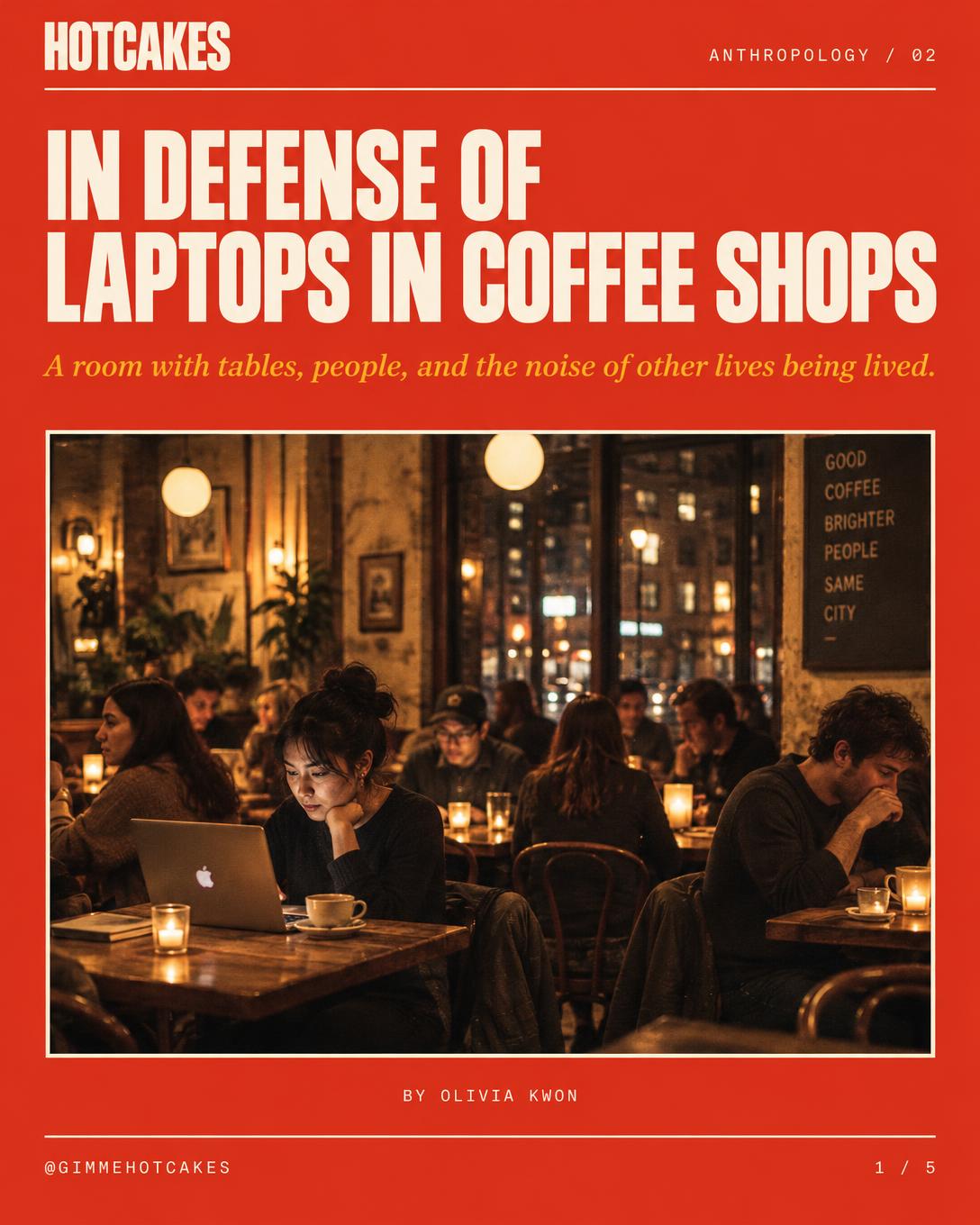
The proof of how much we have already lost is in the technological scramble to manufacture its substitute. As startups for dating and friendship turn experiential — indexing on in-person activity (i.e., 222), locality (i.e., Happn), and degrees of connection (i.e., Cerca) — I find myself thinking that the problem they are attempting to solve already has an answer, and that the answer is a room with tables and people and the noise of other lives being lived. The catch, of course, is that the room only works if people engage with it the way it was designed to be engaged with.
That engagement, when it works, has a particular character. The work happens with the room rather than against it. It absorbs the interruption, the overheard fragment, the laughter from three tables over, as features rather than costs. Conversation, similarly, happens with the room, shaped by the awareness that the clatter and the chatter belong to the space, that the space is shared. And the more you let the room shape you, the more it begins, slowly, to make a place of you.
The question of how we inhabit shared spaces is, at some level, a question about what kind of city we want to live in and what we are willing to extend to the strangers we live alongside. A question about how we want to be a neighbor, how we want to connect, what we are prepared to tolerate and offer in return. The third space has never been comfortable, has never been perfectly suited to any single purpose, and that is precisely what has always made it worth protecting.
So if you move to a new city, go to the coffee shops. Sit at the table next to other people. Keep your headphones on or take them off. Be present, be porous, be a little disrupted by the room. That is the room doing its work on you, and it is, quietly, the work of becoming a person in a place.
Comments (0)
Loading…
No comments yet.