
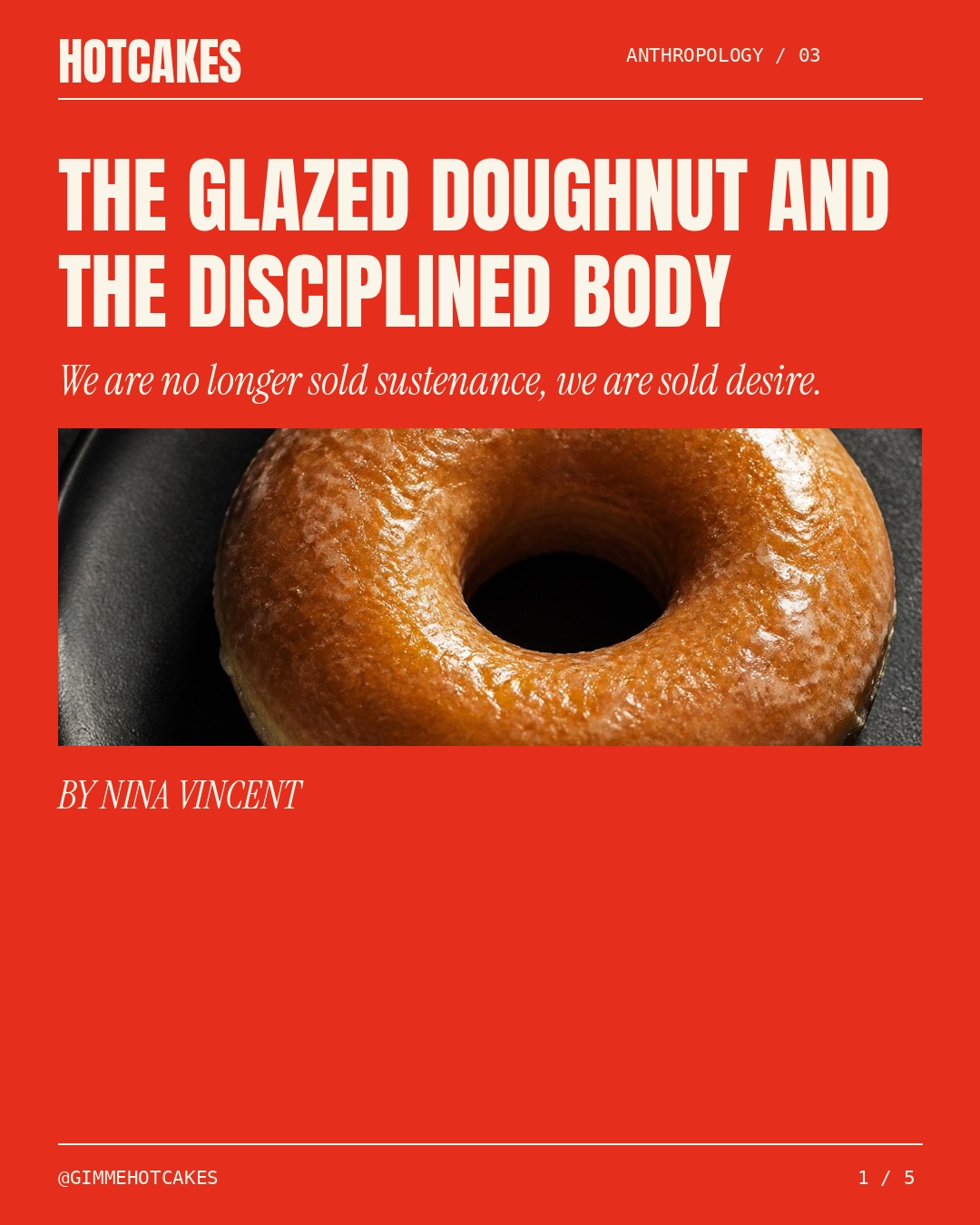
The Glazed Doughnut and the Disciplined Body
Food has become a site of seduction. We are no longer sold sustenance, we are sold desire.

Food has become a site of seduction. We are no longer sold sustenance, we are sold desire.
Food has never looked more sensual. Brands harness the allure of deliciousness to sell products that have little to do with eating. A moisturiser compared to a perfectly glazed doughnut. A lip shade glistening like strawberries folded into thick cream. Cosmetics splayed across café tables alongside frothy cappuccinos, decadent chocolate truffles and flaky croissants. You weren't hungry before, but suddenly you want to know how the foam feels against your lips.
The contradiction is that these images operate within a culture obsessed with thinness. Excess and pleasure are used to make us consume, while restraint and self-control are used to measure our worth.
When so much feels out of our control, the body becomes a site of agency. Rather than a vessel, the neoliberal self treats the body as a project of continuous improvement; something to optimise, refine and correct. There is always another insecurity to fix, another version of yourself to become.
The dichotomy lies in food's role as both fantasy and threat. We are surrounded by images of indulgence while being encouraged to pursue increasingly disciplined bodies. The promise extends beyond appearance. Attractiveness shapes how we move through the world. The halo effect suggests that attractive people are more likely to be perceived as intelligent, successful and trustworthy, while those who fall outside conventional beauty standards are often judged more harshly, profanely bad or even criminal.
Digital life intensifies these pressures. Social media reduces experience to an endless carousel of idealised bodies, each one seemingly fitter, healthier and more desirable than the last. Against this backdrop, food remains one of our most powerful biological rewards. It is no surprise that marketers return to it repeatedly. Glossy chocolate, dripping caramel, thick cream and golden pastry activate something older than reason. The glazed doughnut works so well as a beauty campaign because it borrows the sensuality of food and transfers it onto skincare, fashion and identity itself.
This exists in direct contrast to the expectation that thinness itself carries social value. To be fit and thin is often read as evidence of a life well managed; a body that signals discipline, health and the means to pursue both. The body becomes a visible record of good choices.
Yet even this ideal appears increasingly unstable. As weight-loss drugs make thinness more attainable, simply being slim no longer distinguishes you. Bodies that once signalled exceptional commitment to fitness have become the expected baseline. The athlete's physique is no longer aspirational enough; it is increasingly treated as normal.The ideal body remains just out of reach, shifting shape the moment we get close enough to grasp it.
Perhaps food has become such a powerful marketing language because it exists in tension with the bodies we are encouraged to pursue. The fantasy of indulgence draws its power from restriction. Without restraint, desire would have far less to push against.
Food as a symbolic language
Anthropologist Claude Lévi-Strauss argued that food functions almost like a language: a symbolic system humans use to classify the world around them. Food categories often correspond to body categories, with culinary practices regulating hunger, social relationships and ideas about personhood. The significance of food lies in the meanings attached to it and the ways those meanings shape how people understand themselves and others.
In some ndigenous Colombian communities documented by Arcand, honey was categorised as “very wet” and restricted during menstruation because menstruating women were already understood as excessively wet. Consuming honey risked intensifying this state and disrupting the balance of the body. Cooking itself was understood as a transformative act capable of altering bodily states and social relationships, revealing food as a moral and social code through which societies organise ideas about purity, sexuality, control, gender and desire.
What makes Arcand's example feel surprisingly contemporary is the assumption that food can alter bodily states. Honey carried transformative properties. Modern wellness culture operates through a similar logic, encouraging the consumption of foods that promise to cleanse, detoxify, heal, balance hormones or reduce inflammation. Particular buzzwords become attached to products so that eating feels connected to progress. "High protein". "Low sugar". "Gut healthy". Every label points towards a future version of the self. Food becomes a technology of transformation.
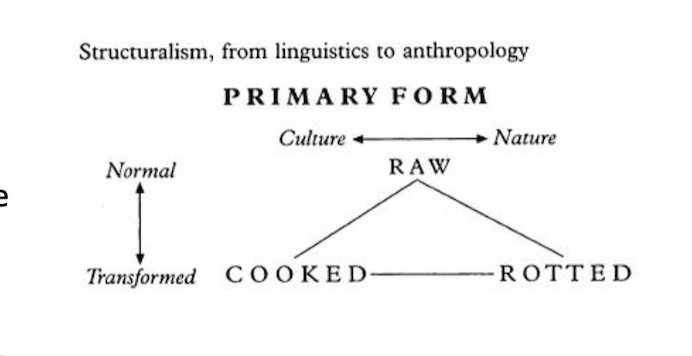
Food continues to function as a way of managing the body, regulating desire and moving closer towards an ideal state. The language has changed, the logic remains familiar. Arcand's distinction between wet and dry no longer feels entirely foreign. Bodies are expected to appear lean, sculpted and de-bloated. Tight. Controlled. Almost dry.
Contemporary wellness culture may appear more rational, yet we continue to categorise foods morally, only with different language. Foods are "clean" and "whole" or "naughty" and reserved for a "cheat day". The concept of a cheat day is revealing. To deviate from ideals of health is framed as something shameful, almost an act of infidelity against the disciplined self. Even our language suggests food is never neutral. It is virtue. Failure. Control.
Food and sexuality
Food and sexuality are deeply connected because both revolve around appetite. Contemporary food culture operates through a similar logic to sexuality: temptation is aestheticised while indulgence remains morally loaded. We are encouraged to desire constantly, but consume carefully.
This creates an impossible balancing act. People who eat "too much" are shamed for lacking discipline, yet those who monitor every calorie risk being dismissed as obsessive. Like sexuality, there is no entirely safe position. Excess is criticised, while restraint is mocked as joyless asceticism. The foods most associated with pleasure are often those framed as transgressive. We do not describe salads as decadent. The language of indulgence is reserved for foods we are simultaneously told to resist. Temptation and restraint are not opposing forces. Each relies upon the other.
The body is where these contradictions become visible. Eating reveals something about us, which is precisely why appetite attracts so much judgement. Throughout history, women have often been caught between competing demands: to be desirable but not desiring, sensual but controlled. The same ideas of purity and disgust that have long shaped attitudes towards female sexuality continue to circulate around food. A woman who overeats, who isn't contained, who consumes in excess, threatens expectations of restraint and self-control. Appetite attracts scrutiny the moment it becomes visible. Wanting too much. Enjoying too openly. Taking up too much space.
Thinness functions as evidence that appetite has been successfully managed. The disciplined body reassures us that desire exists, yet remains under control. What is admired is mastery. Surrounded by images designed to stimulate appetite, we are rewarded for proving we can resist it. Pleasure remains everywhere, increasingly as an image, a fantasy or an aesthetic. The body becomes evidence of whether we have surrendered to temptation or successfully contained it.
Desire without satisfaction
So it is clear we are sold two competing fantasies: expected to desire but stay contained, to eat but never fully indulge. To make sense of these contradictions, it is worth questioning what kind of system benefits from teasing us with desire while withholding satisfaction.
A state of perpetual wanting is highly compatible with a marketplace that depends on aspiration. New insecurities can always be created, with a product positioned as the solution. Wellness runs on self-improvement, a manifestation of the idea that the self is something to be managed. The beauty industry is built upon the promise of becoming. The ideal consumer continues wanting.
Food has given societies a place to locate these desires for centuries. It has helped organise ideas about pleasure, morality, kinship and belonging. Today it remains a powerful cultural symbol because desire can circulate endlessly around it without ever needing to be resolved. We admire indulgence, build aesthetics around it, buy products inspired by it and weave it into our identities, often without ever reaching anything that resembles satisfaction.
The glazed doughnut and the disciplined body are not opposites. They belong to the same economy of desire. One stimulates appetite. The other demonstrates control over it. Never before have we been surrounded by so many images designed to provoke desire while simultaneously rewarding restraint. We are encouraged to indulge aesthetically while remaining disciplined physically.
Pleasure is everywhere. Satisfaction remains elusive. We are invited to want constantly, yet rarely allowed to gratify.
Comments (0)
Loading…
No comments yet.