Eat Your Way to Becoming a New Yorker
The delis, counters, and corner slices that turn a newcomer into a local, one order at a time.
Becoming a New Yorker comes with a long and undefined initiation period. Some set the wait at 5 years; others set it at 10. True sticklers argue that being born and raised here is the only legitimate path. Regardless of your orthodoxy, the root logic of these competing thresholds is simple: the title of New Yorker is a sacred credential.
For me, earning the member’s card is less about how long you’ve been here and more about how you’ve spent your time here. Beyond an arbitrary time gate, being a New Yorker is about living like a New Yorker. Which, of course, means eating like a New Yorker.
Eating like a New Yorker — like New Yorkers themselves — comes in all shapes and sizes. Arguably the food capital of the world, New York offers breadth and depth at scale: nearly every global cuisine, down to its sub-regions, at every price point and in every format. From $400 omakase counters to the dollar-slice window, at over 23,000 restaurants, the culinary landscape is wider than anybody’s stomach could ever accommodate (look what happened to Pete Wells!).
Despite this expansive and ever-changing network of storefronts and stands, some experiences persist as culinary throughlines. These institutions, as relevant today as they were 100 years ago, have an attitude of unfussy excellence that feels distinctly New York, and their dishes have grown into a sort of collective memory connecting generations. Working through them all is no small pursuit, but there is truly no better way to absorb the spirit of a city than to eat your way through it.
The Sit-Down, Historic Americana(ish)
As a great American city, New York obviously has no shortage of great American restaurants. The best of them trade less on novelty than on continuity: the same booths, the same bartenders, the same menus, which rarely stray from the classic American canon of burgers and steaks.
Upscale New York burgers can be acquired at JG Melon (Upper East Side) or Minetta Tavern (Greenwich Village). A decades-old Manhattan fixture, JG Melon is known for its relatively minimalist take on a burger: a thick patty topped with melted American cheese, dill pickles, and raw red onions. Minetta provides a similarly thick patty for its Black Label Burger. Heaped with caramelized onions and served sauceless, it was Anthony Bourdain’s favorite burger in the city. For a quick post-work dinner, I always loved grabbing a bite at Fanelli Cafe, a SoHo fixture since 1847 that has a fantastic thin-patty bar burger.
While I am relatively indifferent to steak, you can’t make a list of the city’s institutions without mentioning its steakhouses: landmarks like Delmonico’s and Peter Luger are famed spots that have been feeding the city for well over a century. Delmonico’s in the Financial District is often called the country’s first fine-dining restaurant (founded in 1837) and is known for its eggs Benedict, baked Alaska, and the Delmonico steak. As for Peter Luger, the Williamsburg steakhouse founded in 1887 has built its reputation on a porterhouse, dry-aged in-house and accompanied by thick-cut bacon and creamed spinach.
The New York (Re)Invention
One of my favorite Subway Takes (Kareem Rahma’s hot-take series) is: “There’s no such thing as the best coffee or bagel or pizza slice in New York City.” To me, the take was incredibly self-evident: New York food is good everywhere in New York.
Pizza is a prime example. At one end are the classic slice shops: Joe’s and Joe & Pat’s (not to be mistaken for one another) are such key landmarks that they have become tourist hubs. New wave slice shops like L’Industrie and Mama’s Too are growing just as popular with tourists and locals alike, with ambitious topping selections like fig jam and bacon or hot honey and pepperoni. For a sit-down meal, upscale pizzerias like Lucali, Stretch, and Una (twice named the world’s best pizzeria by Italy’s 50 Top Pizza) provide a fuller dining experience. And of course there are the “nameless” dollar-slice shops — a classic Friday dinner for my roommate and me — where the meal is more about convenience than craft. Breadth, depth, it’s all there.
I group bagels and hot dogs into this category. Apollo, Leon’s, and Pop Up are all recent arrivals and have lines to match, to me a signal that New York’s appetite for a bagel is something intrinsic to the city itself. Hot dogs generally inspire fewer debates, but maintain a similar foothold in my diet; my most repeated come from either the Central Park stands or Gray’s Papaya.
Given the sheer volume of places serving these staples, the baseline is unusually high. So skipping the lines and trusting the nearest counter is a safe bet. Or fold the meal into another New York experience: a hot dog at Coney Island or a Mets game, Adel’s Halal on the way home from a night out.
The New York Bodega
If the Subway Take holds true anywhere, it is at the bodega, which I would argue is the most legendary New York fixture of all. Open 24 hours (or somewhere close to it), bodegas are part corner store and part sandwich counter, delivering the most convenience of any business in the city.
The bodega’s entire value is proximity, and loyalty to one is less a matter of taste than of geography. The best bodega is, by definition, the one on your corner. And the best order, by definition, is your favorite item on its overwhelmingly expansive menu.
While the bodega is more of an experience than a meal, one dish defines it, and it is one of the few true New York food inventions: the chopped cheese. Widely credited to Hajji’s in East Harlem, the chopped cheese is, as its name implies, a chopped-up burger with melted cheese on a roll. The bite is greasy and indulgent and, in my opinion, a must-try for anyone visiting.
Cultural History
Much like the dishes that have become totems of New York, there are cuisines, carried here by immigrant communities and the enclaves they built, that have become inseparable from the city’s identity.
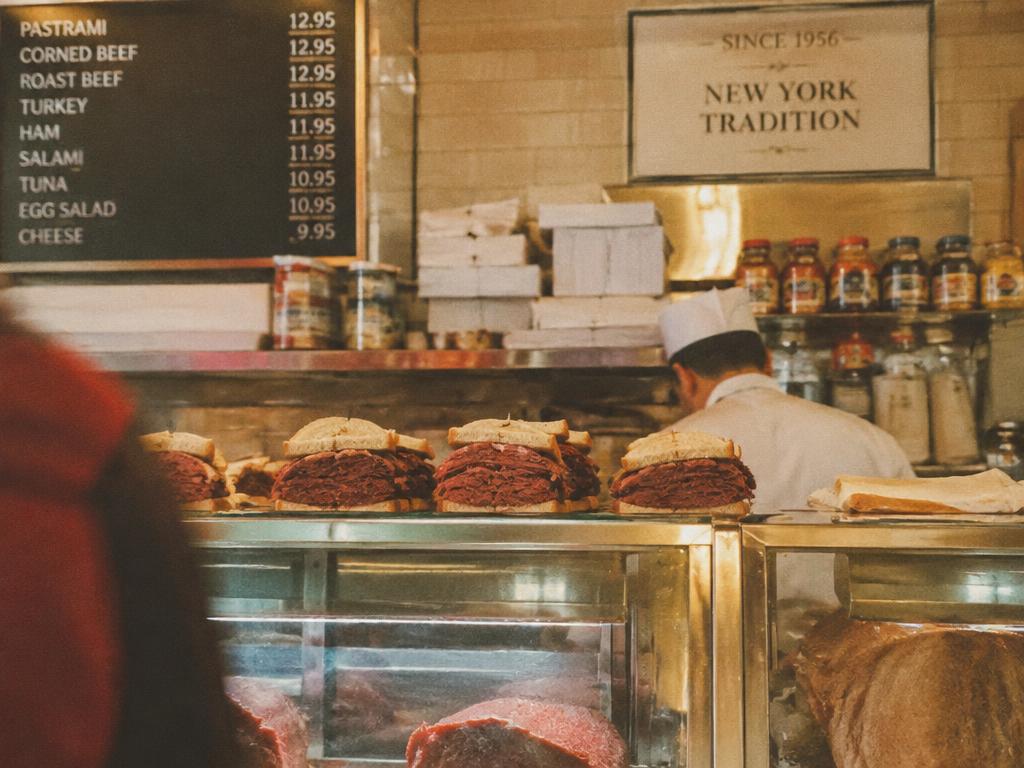
My great-uncle was a born-and-bred New Yorker raised in Queens, and I grew up eating at many of the Jewish spots he took my mom to when she first moved to the city. I’ve always held a soft spot for the classic Jewish breakfast spots like Barney Greengrass, S&P, and Russ & Daughters, especially for bagels and lox, a knish, or a latke with sauerkraut and sour cream. Spots I associate more with dinner, like Katz’s Deli (home to my favorite matzo ball soup), are great for a strangely timed weekday meal (when the line is less likely to outweigh the food). The Upper West Side would be nothing without Zabar’s, a specialty food market which sells smoked fish by the pound alongside surprisingly delicious to-go empanadas and bao buns.
Italian restaurants are just as foundational. Bamonte’s and Emilio’s Ballato, founded in 1900 and 1956 respectively, belong to a lineage of old New York rooms serving classic red-sauce Italian. Bar Ferdinando, which opened this year as the rescue of the 121-year-old Ferdinando’s Focacceria, is part of a growing nouveau historic landscape of long-standing names that have gotten facelifts in the last few years (e.g., Le Veau d’Or).
Old spots like these exist in every corner of the city. In Chinatown, Nom Wah has been serving dim sum on Doyers Street since 1920, a short walk from Wo Hop, the basement Cantonese standby on Mott. Veselka has been making pierogi in the East Village since 1954; in Harlem, Sylvia’s and Amy Ruth’s remain soul food anchors.
No meal is complete without dessert, and the city’s old bakeries carry the same history and nostalgia as its restaurants. The Hungarian Pastry Shop in Morningside Heights has been selling jam-filled strudels since 1961, and Veniero’s, my childhood favorite for rainbow cookies and thumbprints, has been in the East Village since 1894.
~
Eating like a real New Yorker is an exercise in range. But wherever it happens — in a steakhouse booth, over a chopped cheese on the sidewalk, or while riffling through a box of cookies — the real experience is built by finding your favorites and going back to them. Visiting these places, becoming a regular, and sharing them with your friends is the most New York thing you can do. Happy eating!
Comments (0)
Loading…
No comments yet.